Twenty-five years ago I found myself in the most unlikely place for an art gallery: Las Vegas’ Bellagio Hotel. If you’ve ever been to Las Vegas, you know that its primary attractions do not include art galleries; this specific hotel is known for its musical fountain show and nearly nine acre man-made lake: smack in the middle of a desert, no less.
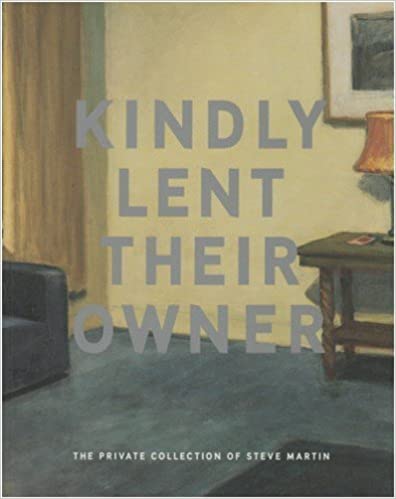
Still, I was intrigued by the art collection in this majestic, albeit somewhat gaudy, setting. It featured the private art collection of Steve Martin–you know him as the comedian, Saturday Night Live alumnus, and musician (he plays one hell of a banjo and has garnered a Grammy award for that talent).
Even more so, I was intrigued by the exhibition’s title: “Kindly Let Their Owner,” so much so that I bought the accompanying catalogue, not only to remember the visit, but the title. “Kindly Lent Their Owner” intrigued me at the time and does this day; I even looked up its origin these 25 years later.
A quick AI assisted search revealed that the phrase is “a clever spin on the standard museum credit line, “Kindly lent by their owners,” as well as having its origin in the nineteenth-century artist James Whistler (he of “Whistler’s Mother”) cracking a joke when leaving out the word “by” in order to suggest that all artwork is simply ours for now, passing through our hands, temporarily , until it ultimately becomes the property of others once we are gone. The artwork is timeless (how often have you heard that phrase?), but our ownership of it is temporal. We are its current owners, but it ultimately is not ours to keep.
That got me thinking.
What do I think I “own?” Is it a house? Is it a car? How about everything in that house or in that car? Is it really mine or “kindly lent?”
I remember many years ago when our son was young he and I were outside on the rear deck of our rural Rhode Island home, pondering the heavily treed forest, beneath a highly lit sky. Corey, my son, turned to me and said “did you ever think about how that tree,” pointing to one majestic oak in particular, “is yours, that you own it?”
I had a flashback to Las Vegas, a place that could not possibly be more different from where I stood at that moment, and the art collection I’d seen there.
We then, father and son, went on to talk about how this house, like all of the New England town in which we live, was built on Native American land. We are merely entrusted, for now, with its ownership. The trees themselves, the soil, the rocks, the animals and their descendants, all existed here hundreds, if not thousands, of years before us. They were being lent to us. the “owners,” until such time as they are “lent” to someone else.
In a time when so much focuses on what “we” own–whether individually or as a nation–“Kindly Lent Their Owner” presents a lesson, at least it does to me and, I hope, to you. Another great comedian and social commentator, George Carlin (ironically, I once saw him perform in Las Vegas–maybe the town has educational value, after all!) had a routine he called “Stuff.” It went something like this:
A house is just a pile of stuff with a cover on it. You can see that when you’re taking off in an airplane. You look down, you see everybody’s got a little pile of stuff. All the little piles of stuff. And when you leave your house, you gotta lock it up. Wouldn’t want somebody to come by and take some of your stuff. They always take the good stuff. They never bother with that crap you’re saving. All they want is the shiny stuff. That’s what your house is, a place to keep your stuff while you go out and get…more stuff!
That stuck with me when a close friend, and fabulous musician, named Jimmy Berger and I wrote a song last year titled “Gratitude.” I penned the lyric:
“You can take the stuff,
But leave the dream
When all is said and done
It’s only you and me.”
On Father’s Day weekend this year I found myself talking with my fellow father-in-law about all of this .We are both of an age and have had careers where we believed that all the stuff we accumulated was what we “owned” and that, in itself, defined a certain portion of our self-identity.
But the longer we thought about it (and I harkened back to “Kindly Lent Their Owner,” Carlin, and “Gratitude,” the more we got “it.”
All we really own in this life is what we have the time to enjoy while we’re here and, when we’re gone, “lend” to our children, grandchildren, friends, and others in need., in order that they can also enjoy what was “lent” to us. We spend a lifetime working to “own” what we will never really “own” in a permanent sense beyond this life. It has been “kindly lent,” us; it is, temporarily, “ours.” What we truly “own” isn’t a piece of art or a home or any variety of things. It is what we alone possess: the love of family, the kindness of strangers, and the community of friends. That’s the “stuff” that can’t be lent, and it also can’t be stolen.